AnIntro2RTutorial
An Introduction to R Tutorial
This tutorial can be used by students to get working with R using RStudio. It is intended to be used by someone that has not used R before.
I use this material for both my Ecologia Numérica and my Modelação Ecológica at FCUL courses 1.
All the relevant material is available here at the corresponding github repository.
Quick start
To start using this tutorial right away download 2 the contents of the corresponding github repository. At a bare minimum, you should first look at the slides at AQuikIntro2RandRStudioInQuarto.html available at Rpubs 3
Then, download (at a bare minimum) these three files:
TAMsIntro2RviaRStudioTutorial.pdf4dados1.csvmydatafile.txt
Then open the PDF and work over it from the top, running the code examples in RStudio. Modify the code as you go, so you can experiment and see how R behaves.
Dynamic reports
These days I tend to work using dynamic reports made in Quarto.
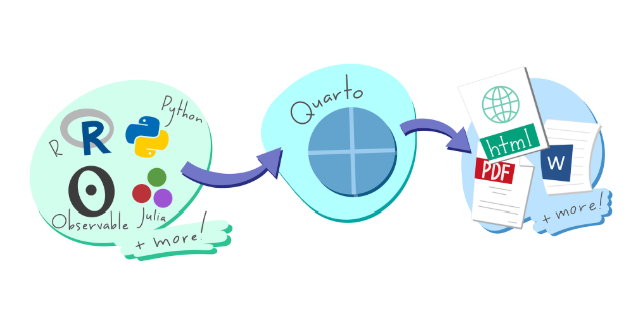
This makes the entire analysis workflow, from reading the data and cleaning it all the way to reporting the results from one’s analysis, integrated and fully reproducible.
Working with dynamic reports is a good skill to have if you are a biology student, and so, if you are a student of one of my courses at FCUL, I will also show you in class how those work. In fact, this will be a highly transferable skill that will be useful in many working environments beyond the analysis of biological/ecological data. Learning from scratch how to work with dynamic reports might be hard, but starting from a template helps. If you want a template for creating dynamic reports, I created one for you here.
My suggestion is that you start by creating your own dynamic report, which you then use as a basis to work with the code and experiment variations of the code in this tutorial.
Tips before you go
Keep all your code properly commented: what seems obvious to you today might not be obvious to the “you” next week or next month. Coding is a collaborative experience, even if between you and your future self (This quote, or something similar, might be from Hadley Hickam).
If you are new to R in general, the R cheat sheets are great resources, and I recommend to begin with downloading these:
If you want to learn R interactively from the command line, you might want to try package Swirl. Your own R tutor at your fingertips. Try it!
Additional online resources
Below I also provide a list of additional free online resources that you might want to consider as additional R learning resources. Some of these resources are not about R itself, but about some relevant aspect of statistics that uses R. If you happen to know about a good resource to add to the list below, send me the link and I’ll add it below.
This is a non-exhaustive, non-comprehensive and quite random list of R (and related) resources that I found useful at some point. They might (but will not necessarily) be ecologically oriented. Feel free to explore at your own risk. No real order in the list I am afraid.
General R
-
The Big Book of R as per the author, Oscar Baruffa, hopefully this is the only bookmark you’ll need in future ;). Over 400 books on R programing, organized by topic area
-
Ten simple rules for teaching yourself R - Lawler et al. with a “Ten simple rules” paper for teaching yourself R
-
Introduction to R with Tidyverse course This is a course by Sophie Lee “designed to equip you with the essential skills to leverage the power of R and Tidyverse for their work. The course begins with a gentle introduction to the user-friendly RStudio interface and the basics of the R coding language, or syntax. This makes it ideal for anyone with little or no prior coding experience, or those looking for a refresher of the basics.”
-
A set of R tutorials While the adds on the webpage are a bit annoying, the content is worth it and there are several free tutorials to learn R at your own pace.
-
Writing Better R Code here you can find the material for a course entitled “Writing Better R Code” by Nicola Rennie, including the course slides
R for statistics and data science
-
An R companion to Statistical Thinking for the 21st Century a free companion to the book An R companion to Statistical Thinking for the 21st Century 2020 by Russell A. Poldrack
-
The R Language: An Engine for Bioinformatics and Data Science Giorgi et al. describe the history of the R language.
-
Telling Stories with Data: With Applications in R - a great book by @RohanAlexander Rohan Alexander about telling stories with data. Effective and reliable stories in a reproducible framework.
-
A course on GAM’s by Noam Ross
-
Introduction to Linear, Generalized, and Mixed/Multilevel models with R by Francisco Rodriguez-Sanchez (the first couple of slides are fantastic introduction to modern statistical analysis in a unified GLM framework). Found about this via a tweet.
-
Data Analysis in R by Steve Midway
-
A User’s Guide to Statistical Inference and Regression Notes for Government 2002: Quantitative Social Science Methods II at Harvard University, taught by Matthew Blackwell. It provides a rigorous yet accessible introduction to the foundational topics in statistical inference with a special application to linear regression. The material is intended for first-year PhD students in political science, but it may be of interest more broadly, say to biologists, lol! ~
-
Improving Your Statistical Inferences not just about R nor even R focused, but damn this is a great resource by Daniel Lakens!
-
Statistical Rethinking (2023 Edition) if you want to get your mind blown and change the way you see statistics, embracing the Bayesian paradigm, all from within R, then this course from Richard McElreath is your one stop shop! It includes the pre-recorded lectures, the slides, homework and respective solutions, all based on the quickly becoming a classing book “Statistical Rethinking” (for the actual book, well worth it, see here.
-
Guide to Effect Sizes and Confidence Intervals This effect sizes and confidence intervals collaborative guide aims to provide academics, students and researchers with hands-on, step-by-step instructions for calculating effect sizes and confidence intervals for common statistical tests used in the behavioral, cognitive and social sciences, particularly when original data are not available and when reported information is incomplete. It also introduces general background information on effect sizes and confidence intervals, as well as useful R packages for their calculation. Many of the methods and procedures described in this Guide are based on R or R-based Shiny Apps developed by the science community.
-
Introduction to Data Analysis in R Andrew Proctor’s course on Introduction to Data Analysis in R, including webpages, slides, exercises, solutions, code, etc.
-
Statistical Thinking for the 21st Century The goal of this book by Russell A. Poldrack is “to the tell the story of statistics as it is used today by researchers around the world. It’s a different story than the one told in most introductory statistics books, which focus on teaching how to use a set of tools to achieve very specific goals. This book focuses on understanding the basic ideas of statistical thinking — a systematic way of thinking about how we describe the world and use data to make decisions and predictions, all in the context of the inherent uncertainty that exists in the real world”.
-
Bayesian Regression: Theory & Practice - a great course on regression models within a Bayesian framework with package
bmrswith all the materials. Material by Michael Franke -
Learning Statistical Models Through Simulation in R - This textbook approaches statistical analysis through the General Linear Model, taking a simulation-based approach in the R software environment. The overarching goal is to teach students how to translate a description of the design of a study into a linear model to analyze data from that study. The focus is on the skills needed to analyze data from psychology experiments. Material from a course aught by Dale Barr at the University of Glasgow School of Psychology. It is part of the PsyTeachR series of course materials developed by University of Glasgow Psychology staff.
-
Mixed Models with R: Getting started with random effects A nice document by Michael Clark. On his own words: “The goal here is primarily to provide a sense of when one would use mixed models, and a variety of standard techniques to implement them. While it can be seen as a standalone treatment, the document originally served as the basis for a workshop, and from that, exercises are available to practice your skills.”
-
Modern Statistics with R by Mans Thulin, Modern Statistics with R: From wrangling and exploring data to inference and predictive modelling (2024-07-01 - Second edition - Version 2.0.0)
-
Material from Gavin Simpson’s course on GAMs A course on Generalized Additive Models; a data-driven approach to estimating regression models This is part of a suite of Physalia-Courses hosted at https://www.physalia-courses.org/
-
Regression Modeling Strategies a book that is all about regression, by Frank E. Harrel. Jr., that serves as support material for a course by the same author, but can be read independently of the course.
-
Explanatory Model Analysis A book to help you Explore, Explain, and Examine Predictive Models. With examples in R and Python. By Przemyslaw Biecek and Tomasz Burzykowski, edited by CRC.
-
ANOVA and Mixed Models: A Short Introduction Using R The free version of the CRC book by Lukas Meier, a great resource for those looking for an introduction to the topics with the supporting R code.
-
A course on GAMs This is the 2023 course website for a 2 day generalized additive modelling course put on by BioSS for UKCEH. The instructors for the course were Dave Miller and Thomas Cornulier.
-
R for Statistical Learning by David Dalpiaz - This book currently serves as a supplement to An Introduction to Statistical Learning for STAT 432 - Basics of Statistical Learning at the University of Illinois at Urbana-Champaign.
R for ecology
-
Introduction to R for Biologists by Maria Doyle, Jessica Chung, Vicky Perreau
-
Introduction to R for Biologists by Sheri Sanders
-
R for biologists - the name says it all
-
R Crash Course for Biologists - This is a great resource, a git repos by R.I. Colauti, that includes also other crash courses in stats etc
-
Fundamentals of R for Biologists Fundamentals of R for Biologists is a self-guided crash course in how to use R specifically geared for those working in the biological sciences. All of the lessons in this course are bundled together into a single PDF textbook: Fundamentals of R for Biologists.
-
Luka Negoita’s webpage Including some self-paced online courses, for ecologists and biologists, that simplify the R learning process, so you can quickly gain confidence in handling your own data. (while some resources are free, most are paid). One free bit which is very useful lists 5 great sources of free ecological datasets that you can use to practice R within an ecological framework
-
Biostatistics with R: An Introduction to Statistics Through Biological Data Babak Shahbaba’s UseR book on Biostatistics with R: An Introduction to Statistics Through Biological Data
-
Statistics for Ecologists by John Fieberg. In his own words: “Ecological data pose many challenges to statistical inference. Most data come from observational studies rather than designed experiments; observational units are frequently sampled repeatedly over time, resulting in multiple, non-independent measurements; response data are often binary (e.g., presence-absence data) or non-negative integers (e.g.., counts), and therefore, the data do not fit the standard assumptions of linear regression (Normality, independence, and constant variance). This book will familiarize readers with modern statistical methods that address these complexities using both frequentist and Bayesian frameworks.”
-
Biological Data Science with R This book was written as a companion to a series of courses taught by Stephen D. Turner at the University of Virginia introducing the essentials of biological data science with R.
-
Análises Ecológicas no R A book in Portuguese about ecological analises in R. There are over 600 pages of material and respective code. Well worth exploring!
R for (medical) biostatistics
-
Geospatial Health Data: Modeling and Visualization with R-INLA and Shiny - a free version of the CRC book by Paula Moraga
-
Biostatistics for Biomedical Research The book is aimed at exposing biomedical researchers to modern biostatistical methods and statistical graphics, highlighting those methods that make fewer assumptions, including nonparametric statistics and robust statistical measures. In addition to covering traditional estimation and inferential techniques, the course contrasts those with the Bayesian approach, and also includes several components that have been increasingly important in the past few years, such as challenges of high-dimensional data analysis, modeling for observational treatment comparisons, analysis of differential treatment effect (heterogeneity of treatment effect), statistical methods for biomarker research, medical diagnostic research, and methods for reproducible research.
-
A short course on Survival Analysis A short course on Survival Analysis applied to the Financial Industry, for BBVA Data & Analytics, Madrid, by Marta Sestelo This book is designed to provide a guide for a short course on survival analysis. Focused on applying survival analysis statistical techniques to the financial industry. The emphasis is placed in understanding the methods, building intuition about when applying each of them and showing their application through the use of R.
R as a GIS
-
GIS and mapping in R: Introduction to the sf package by Olivier Gimenez
-
An Introduction to Spatial Data Analysis and Statistics: A Course in R by Antonio Paez
-
Spatial Data Visualization with tmap A Practical Guide to Thematic Mapping in R. This book is a hands-on, open-source resource for anyone interested in creating maps using R and the tmap package.
-
Geocomputation with R a book by Robin Lovelace, Jakub Nowosad and Jannes Muenchow on geographic data analysis, visualization and modeling.
-
Intro to GIS and Spatial Analysis Lecture notes for a course with the same name by Manuel Gimond
-
R as GIS for Economists A bookdown book by Taro Mieno. In his own words: “This book is specifically aimed at spatial data processing for empirical statistical projects, where spatial variables become part of the analysis dataset. Over the years, I have seen many students and researchers spend excessive time just processing spatial data, often by endlessly clicking through the ArcGIS (or QGIS) user interface. From an academic productivity perspective, this is a waste of time. My hope is that this book helps researchers become more proficient in spatial data processing, ultimately enhancing productivity in economics and other scientific fields where spatial data is essential.”
R6 (aka Rather Random Restrict-Realm R Resources)
-
Bayesian analysis of capture-recapture data with hidden Markov models a great book by Olivier Gimenez, colleague and friend, on the theory behind capture recapture models, how to frame the models as hidden Markov models, and useful case studies in R and NIMBLE.
-
Doing Meta-Analysis with R: A Hands-On Guide This book serves as an accessible introduction into how meta-analyses can be conducted in R. Essential steps for meta-analysis are covered, including pooling of outcome measures, forest plots, heterogeneity diagnostics, subgroup analyses, meta-regression, methods to control for publication bias, risk of bias assessments and plotting tools.
-
Resources to lower stats anxiety - A stats clinic, a collection of resources developed by Glenna Nightingale. Take a peak, there’s videos, shiny apps, data stories, etc.
-
Marginal effects - This free online book introduces a conceptual framework to clearly define statistical quantities of interest, and shows how to estimate those quantities using the
marginaleffectspackage for R and Python. The techniques introduced can enhance the interpretability of over 100 classes of statistical and machine learning models, including linear, GLM, GAM, mixed-effects, bayesian, categorical outcomes, XGBoost, and more. -
R charts A great resource by “R Coder” that lets you see hundreds of R graph examples and provides all the code to reproduce them, making it easily extendable to your own data, using both base R and
ggplot2, as well as other packages for some more niche graphs.
Footnotes
-
If you are a student in one of those courses the tutorial section
Final tasksis only intended to be completed for those inModelação Ecológica. ↩ -
If you are new to RStudio this presentation can be helpful in getting you started. If you are a student of one of my courses at FCUL, this presentation will be delivered to you in class. ↩
-
This was made for biology students. I assume you don’t know your way around github. If you do, feel free to clone the repository and provide comments and raise issues that way. If you do not know github, ignore this! ↩
-
The file
TAMsIntro2RviaRStudioTutorial.pdfwas generated by compilingTAMsIntro2RviaRStudioTutorial.qmd, a Quarto dynamic report. In the github repository there are correspondingTAMsIntro2RviaRStudioTutorial.htmlandTAMsIntro2RviaRStudioTutorial.docxfiles if you prefer to work from these formats. Or, you can compile them yourself from the.qmdas a test to see your work in different output styles. ↩